
Boost your confidence in the competency and experience of installers who are working to construct your designs
Anchor Installation Training
While post-installed anchors have the potential to bring numerous performance and productivity gains to your projects, a big influencing factor whether these benefits are realised is the quality of installation.
Installing post-installed anchors can be a complicated task given different manufacturers or even different products from the same supplier can have different procedures to follow. Installing anchors is definitely not a one size fits all and while there are commonalities depending on the type of anchor (chemical, mechanical, expansion type etc.) the correct steps and processes should be checked specifically for the product being used.
Given the sensitivity of post-installed anchors performance to the installation method and quality, Hilti's SAFESET systems can be specified and utilised as outlined in our previous article, but there is still more that can be done.
In the past few years we have definitely seen an increase in project requirements for installers of post-installed anchors to have conducted appropriate training. In this article
we'll look at references to such training being recommended in different sources and outline what such training sessions would involve.
What the Standards say
Commonly referred to as the anchor design standard, AS5216 - Design of post-installed and cast-in fastenings in concrete Appendix B contains a section on Means for demonstrating conformance to the standard, specific to installation in section B.2
"The Installer of the Fastener should possess the necessary experience and competency in undertaking the installation of the fastener as per the manufacturer's installation instructions. An installer's competency for installation of a fastener in a safety-critical application may be demonstrated via voluntary certification through the AEFAC Certification Program and/or by specific training from the supplier of the product being installed"
The Bridge Design standard AS5100 also highlights similarly in Section 8.8 Post-installed fasteners
"The installation of the fastener shall be carried out by a person certified by the Australian Engineered Fasteners and Anchors Council or evidence shall be provided of competency acceptable to the relevant authority"
Even the European Technical Assessment (ETA approval) document for specific post-installed anchor products typically contain a section on installation requirements:
"Fastener installation carried out by appropriately qualified personnel and under the supervision of the person responsible for technical matters of the site"
What are the options?
There are 2 ways through which installers are able to demonstrate they are appropriately trained but also have the necessary experience and competency to carry out the task:
The Australian Engineered Fasteners and Anchors Council offer their formal Installer Certification Program which includes a structured assessment or examination as well as an ongoing recertification period. More information about the program can be found HERE
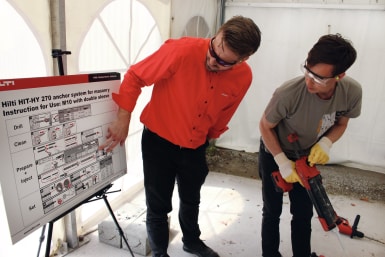
The alternative to the AEFAC program would be training by the supplier of the product. Given Hilti is an end to end R&D, manufacture & supplier who partners with our customers with an array of services, we are uniquely positioned to provide a high level of support for such training.
The training Hilti can provide for such requests can either be specific to the installation of the specific anchors being used on a project OR a comprehensive overview of our portfolio of products in which we can cover different working principles and mechanisms as well as watch outs and key installation steps and techniques.
Depending on the type of training requested, it can range from a short 30 minutes to an hour session or extend to a comprehensive 3-4 hours. The training will involve both a theoretical session covering compliance requirements, working principles as well as risks and mitigation techniques followed by a practical segment where the participants will observe or part take in installation of the relevant anchor(s).
If you'd like to discuss any of the above or would like to engage us for Installation training service, please reach out to your dedicated Hilti Account Manager, Engineer or comment below.
