
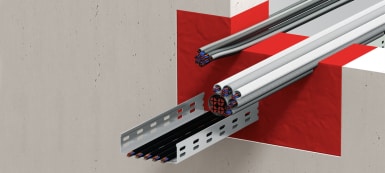
Hilti offers a variety of solutions for easy design and specification
Failing to consider passive firestopping of cables by an architect or planning engineer in an early project phase will inevitably lead to problems in later construction phases and can endanger the approval of the building. Costly and complex rework, unplanned expenditure and extensive changes of complete cable runs through fire-rated walls or floors are very common implications. It is therefore advisable to consider passive firestopping as early as possible and to work on an exact, detailed and professionally planned specification. This article gives advice to all electrical engineers who are looking for an easier and better planning of firestop cable penetrations, as well as explaining its advantages and the benefits of Hilti’s broad range of innovative solutions for cable penetrations.
Problems caused by a lack of planning
Engineers involved in planning electrical equipment and cabling in a building are frequently confronted with penetrations through fire-rated walls and floors. They are also faced with day-to-day problems and questions from the jobsite about the correct installation of firestop systems. Moreover, they are involved in cases of incorrect installation, in finding deficiencies when doing checkups or inspections, and even in engineering judgement processes. It is very difficult for MEP engineers, electrical designers (such as low voltage specifiers), project architects or technical back-office staff to maintain a high level of application competence and to collect and store firestop product information from all the different manufacturers. In addition, some very significant challenges also come into play, including:
- Approvals, regulations and product information are not always transparent and change quite regularly.
- A constantly growing need for coordination between different trade contractors. How can you better plan trade-specific firestop openings to avoid complexity and mess?
- A low level of detail in specifications and drawings often leads to the selection of the low-priced, sometimes even non-approved solutions and, as a result, a low quality of installation. How can you avoid liability problems and project delays?
- How do I select the right products for my specification?
- How can I minimize legal exposure if firestop products of many different manufacturers are installed in the same building due to a lack of proper specification?
- Firestop still is very complex and requires time and competence. Can I count on someone to give me the best technical engineering support when needed?
Typical mistakes during installation of electrical firestop products
Engineers must also be aware of typical installation problems, including but not limited to:
- Not providing enough workroom for electricians to correctly install firestop systems.
- An inherent plan with large openings gives freedom to all involved trades to pull all kinds of different penetrants through one opening.
- Cable trays cannot be installed without fixing or supporting elements.
- Chaotic cable routing.
- Cables routed through an opening without the necessary and required bend radius.
- “Blind” specification (copying/pasting from older specifications or documents) leading to a generic firestop solution without knowledge of the potential source of errors.
- Leakages, open gaps and unsealed areas or joints between cables in the opening.
- No adherence to minimum distances.
- Missing documentation of installed systems.
Bottom line, these mistakes can only be prevented through professional, early predesign planning. This makes the whole subsequent process easier, smoother and clearer for all stakeholders.
Key criteria to consider for firestop cable applications
Cable type, diameters and fire resistance ratings: in an RIR (Regulatory Information Report) or in other approval documents, it is always part of the tested field of application to determine which cable types and cable diameters have achieved which fire resistance ratings and under which conditions. For example: are additional measures required to seal the opening? Which supporting constructions are part of the approval (is the system also tested in a drywall)? Can a cable tray run through the opening? Which cables meet the demanding integrity and insulation test criteria? Large power cables with diameters of ≥50mm mostly face insulation resistance rating challenges. All this needs to be considered when planning how a cable runs through compartments in a way that meets all these requirements.
Cable configuration: in firestop cable applications, we distinguish three main configurations: single cables, cable bundles and cables on a cable tray. For each configuration, there are different optimized product solutions which offer customized approvals and installation benefits for an easy and reliable installation.
Other electrical applications: there are some other special cable applications like conduits, tubes or busbars. Testing firestop systems for these applications is demanding. Not all standard firestop products for cable applications offer a tested solution in the approval document.
Cable load: one important parameter is the so-called cable load. For most products the cable load is restricted to 60% of the opening space. The reason is that enough firestop material is needed to close the gaps created by burned and melted cables. Correct cable load is necessary to reduce the risk of a fire or short circuit that can be caused by too many cables being squeezed together in the area of the penetration.
Multiple cable penetrations: often, different cable configurations (bundles, trays, single cables) are pulled through one larger opening. Then adequate firestop solutions need to be installed. In approval documents therefore, additional parameters have to be considered, such as minimum distances between the cables or from cables to seal edges.
Mixed penetration: one of the biggest pain points is mixed penetrations in large openings. A mixed penetration is a penetration through which cables and different pipes with different pipe materials and insulations are installed. This leads to major installation hassles and increased coordination efforts between mechanical, electrical and specialist trades. It also complicates proper maintenance of such a penetration. It is therefore clearly recommended to plan smaller, better customized and trade-specific openings in an early stage. This potential issue can only be reduced with a conscious and forward-looking provision for void planning by engineers, planners or architects.
Cable re-penetration: a big benefit for owners and facility managers in buildings where regular cable re-penetration or retrofitting is needed (such in hospitals, data centers or industrial facilities) are products that offer both easy cable management with the least amount of effort and time in retrofitting. Firestop pre-engineered sleeves are designed to offer real long-term benefits in these cases.
To avoid these hidden but obvious traps, an early planning of cable runs and a detailed specification of concrete firestop solutions for cable penetrations is crucial.
Easy-to-specify products for many different cable applications
Hilti offers a variety of innovative products for different cable application situations, considering many important requirements and a broad field of application.
In the below table, a simple overview with some selection criteria (not exhaustive) is given to provide at least some simple guidance of the possible advantages for specification engineers (green: preferred).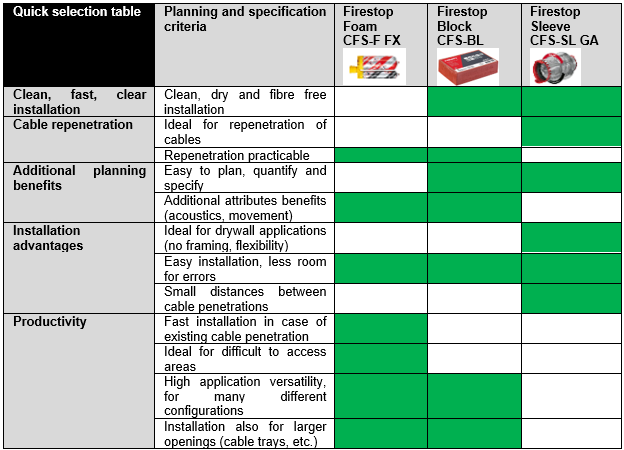
Selection of Hilti pre-engineered solutions dependent on main criteria for engineers
Engineering services and support
Early product specification is crucial to avoid mistakes and hassles in later phases of a project. This is even more important when it comes to the difficult area of fire protection and firestop: this is an area which is legally enforced. It is particularly important for the architectural, design and engineering companies to minimize risks and help safeguard proper and compliant installation of your planned firestop systems. Hilti not only offers a variety of pre-engineered products with a broad approval range for most of the electrical cable applications covered in this article, but also competent and professional engineering support from the early design phases in BIM projects through to onsite support for project managers and installers.
Contact a firestop expert through our Technical Advice Services page.
