
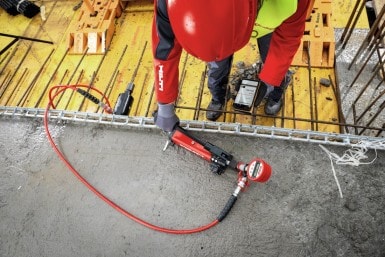
Specifying on site anchor testing can be an effective means of quality control, if done correctly
What is the purpose of On-Site Anchor Testing?
In the previous articles covering strategies to mitigate issues with anchor installation, we've looked at specifying techniques or specific systems to reduce error during the installation process, both from a frequency of occurrence and potential implications on performance. We also looked at requesting or recommending formal and informal training for the installers to further the confidence that a connection designed with post-installed anchors will be installed correctly, ensuring the performance as the design intended. (Link to both previous articles will be at the end for reference). The intention of the 3-part article series which this is the final part, is to provide quality control measures in the design, installation and post-installation or verification phases when looking at using a post-installed anchor on your projects.
As per the title of this article, On-Site Anchor testing is a great method of verifying the installation of post-installed anchors. When we talk about On-Site Anchor Testing, we are referring to a setup and test performed on site of the project to gain better understanding or verify the installation rather than a laboratory setting where a product is tested for assessment of performance characteristics.
Ensuring the correct and appropriate testing methodology are aligned to the expectations of the results is very important and, in this article, we will overview the framework and different types of On-site testing and point to some misunderstandings or discrepancies we experience when providing the site testing service.
First, some guidelines
For the experienced professional involved in post-installed anchor systems, this name should be familiar: Australian Engineered Fasteners and Anchors Council, or AEFAC. AEFAC, as a body or initiative to better the construction industry relating to structural anchors or fasteners, was found by a board of industry partners and Swinburne University of Technology based in Melbourne.
Since its inception, AEFAC has helped standardise the anchor selection and design through its release of SA TS101 which was part of the NCC 2016 which was later superseded by AS5216 and referenced in NCC 2019. AEFAC also publish an ongoing array of useful technical notes, all aiming to improve the specification, selection, design and installation of anchors or fasteners.
Of these technical notes, the one most relevant to this article is TN05: Site Testing Guidelines which exists in 4 volumes:
- TN05 Vol1: General
- TN05 Vol2: Proof Tests
- TN05 Vol3: Ultimate Tests
- TN05 Vol4: Testing in Masonry
AFEAC's TN05 are based on the recommendations in the Bristish Standards "BS8539:2012" as well as the Construction Fixings Association.
Important to note, TN05 in 2023 is currently a standalone Technical Note which aims to provide information and guidelines for best practices regarding on-site anchor testing however is not included in AS5216 or the NCC. Along with the fact that AS5216 does not specify requirements for site testing, this means that site testing is not a mandatory step required for all post-installed anchor installations but is an optional or requirement that can either be from the client or project, the design engineer or the QA-minded contractor.
At Hilti, our On-site Anchor Testing service follows the AEFAC TN05.
For the purpose of this article and increasing jobsite quality and confidence, we'd like to be focusing on proof testing however we will also try to clarify some of the common confusion or misconceptions around ultimate testing and highlight some of the key differences between each to help identify which test methodology to follow and what information and preparation is required accordingly.
Proof Testing
Proof tests can be better explained by being considered to be tests to validate installation quality. This type of test is characterised by the below :
- Tests on site to precalculated proof-load (typically non-destructive, if anchor passes the test)
- Tests performed on anchors intended for use (will be used as part of a connection in the construction project)
- Can test post-installed anchors, post-installed rebar
- Can be performed in all base materials where installation quality is to be verified and documented
- Target proof load to be held for a minimum of 30 seconds with less than 10% of the target proof-load allowed to drop (Hilti service generally performs a minimum of 60 seconds)
- Minimum test population to be greater of either 3 or 2.5% of the sample population
- Can typically be done in both a confined or unconfined test setup
- When failure is observed, target sample size to be doubled and relevant engineer to be alerted before proceeding. If 2 or more samples fail, TN05 recommends all fasteners in population to be tested)
- Validates installation quality, providing confidence in the structural safety of the installed solution
Ultimate Testing
Ultimate tests can be better explained by being considered to be tests to determine resistance. This type of test is characterised by the below:
- Tests on site to either ultimate load (destructive test to failure) or to a precalculated target-load (set by the design engineer aimed to be non-destructive)
- Tests to understand or determine the resistance/performance of the anchor in an unknown base material or condition
- Cannot contradict the data of an approval document (ETA) so is not a valid test for conditions covered by approval documents
- Examples when ultimate tests are appropriate:
- Fastener has approval (ETA) for masonry substrate but the type of masonry, strength or dimensions are outside scope of ETA
- Fastener has approval (ETA) but the application has to be outside scope of the ETA (eg. smaller than minimum edge distance)
- Ultimate tests are carried out on sample population of sacrificial fastenings which should be representative of the intended application (sacrificial fastenings not to be used in actual application)
- Minimum recorded sample to be 5
- Ultimate tests should always be done with unconfined test setup
To summarise the two test methods above, proof testing is most relevant to quality check or validation of the installation of the anchors, where the ultimate tests serve to help the design engineer make informed decisions based on factual test data from the specific jobsite. Also important to note that in some cases, typically the most critical of connections, a mix of both ultimate testing and proof testing can be utilised.
Additional Considerations Before Specifying, Requesting or Performing On Site Testing of Anchors
Here are a few points we'd like to share based on some typical questions we get asked or ask while providing our testing service:
- When testing a chemical anchor, the anchor has to have been allowed the full curing time before testing
- If the anchors are already loaded (tightened to be part of a connection), it cannot be tested
- Proof testing of hex-head anchors are generally not recommended or preferred. Connection to site testing equipment typically requires a threaded connection and connecting a hex-head anchor requires adjustments or reinstallation of anchors which is both not advisable for most anchors but also not an indication of the end performance expected of the anchor as the proof-tested anchor installation is disturbed
- Currently, TN05 does not cover testing in shear. Site testing setup means it is very difficult to apply a shear load on the anchor without resulting in compression around the installed anchor, potentially affecting the readings and results
- TN05 covers testing processes of post-installed anchors, currently not extending to testing of cast-in bolts or headed studs or cast-in anchor channels
- On-site testing results and reports valid for specific products, not to be translated across to different projects
- Fastener population referred in TN05 as: "Group of fasteners representative of the relevant fastener population, having the same type of fastener, the same base material, same installation method and same installation personnel"
Resources and Links
AEFAC Resources to download Technical Notes
Article part 1 covering Hilti's SAFESET Systems
Article part 2 covering anchor installation training
Requesting Hilti's Anchor Testing Service
