

Your guide to firestop systems in top-of wall applications
Passive fire protection systems are integrated into the design of a building to compartmentalize fire areas, restrict the spread of fire and smoke, provide evacuation paths for building occupants, protect assets within buildings, and to increase the efficiency of fire extinguishing efforts.
In most of today’s modern commercial or multi-family residential projects, there will be joints between rated construction assemblies which creates a void, or break, compromising the effectiveness of the compartmentation. Together with the service penetration, construction joints are weak points if left unsealed.
Different types of construction joints will require unique firestop solutions depending not only on the required FRL (fire resistance level), but also on the need to assure the ongoing serviceability of the opening. The additional attributes to be considered are listed on the AS 4072.1 appendix C which include, but are not limited to, movement capabilities in compression and extension, cyclic and acoustic properties, durability, and resistance to cracking after cure.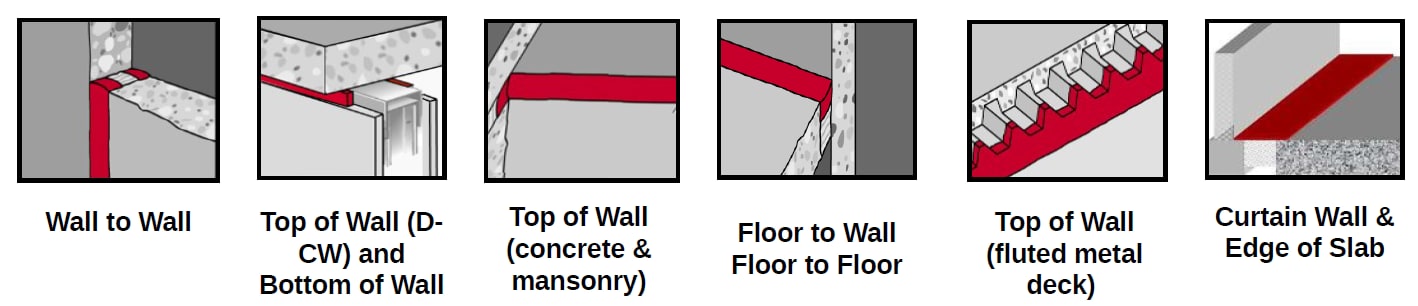
Types of construction joints
Based on the usage and size of the building, some walls will require to be fire and/or acoustic rated and will need to achieve a certain performance. Typically, residential buildings, hospitals and hotels will require a higher share of fire-rated walls in each floor in comparison to open floor offices, for instance.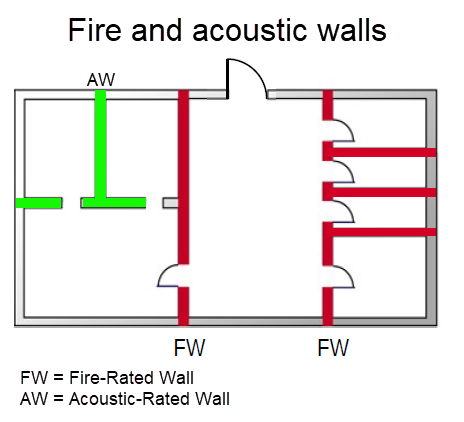
Fire and acoustic rated walls performance requirements will vary depending on building type
Firestop systems for top-of-wall joints in plasterboard
The top-of-wall gaps in plasterboard walls are normally left to allow deflection and movement of the partitions, without causing any damage or cracks in the boards. The thickness of these gaps will depend on the location and design of each building. Where the walls are required to be fire and/or acoustic rated, these joints will need to be sealed to secure the compartmentation of the system.
Beyond the fire protection aspect, normally there are also concerns associated to acoustic and air tightness (related to energy efficiency) and the integrity of the sealing when movements occur. Therefore, the firestop solutions used in those joints must accommodate these additional technical requirements.
Traditionally, those gaps are filled with firestop sealants, on both sides of the top track. The installation of sealant-based solutions is efficient for this application, but the quality of the fire protection is highly dependent on the expertise of the installer and site conditions, including depth and thickness of the product being applied.

Hilti CP 606 is an example of acrylic sealant that is approved for top-of-wall joints
Innovative preformed devices such as Hilti Firestop Top Track Seal CFS-TTS is a next generation top of wall solution, leading to more reliability of installation regardless of labour skill. It eliminates a complete step in the application process as the joint is addressed now of the track installation.

Hilti Firestop Top Track Seal CFS-TTS in top-of-wall plasterboard joint
Hilti Firestop CFS-TTS attributes
The Hilti Firestop Top Track Seal CFS-TTS addresses all aspects of modern interior finishing project requirements offering a list of benefits beyond the passive fire protection.
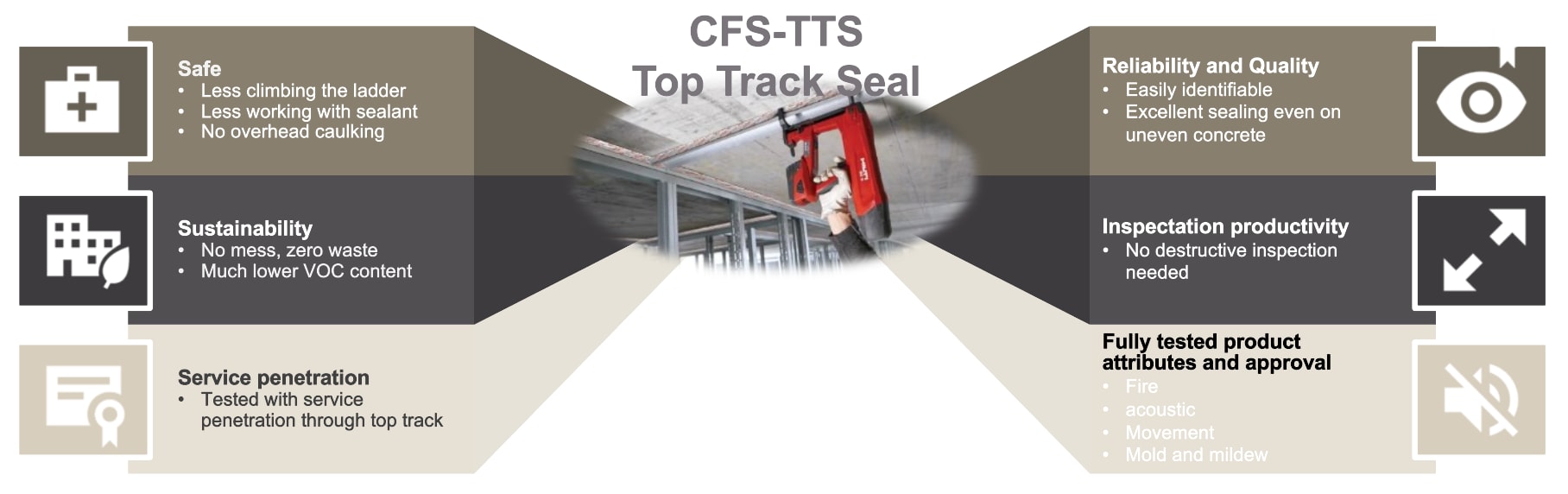 Hilti Firestop Top Track Seal CFS-TTS attributes add value to projects
Safety
By eliminating the need of an extra step to apply the firestop sealant after finishing the walls set up, the overall safety of the application improves as there is less need to work overhead on a ladder or platform. There is also no chemical handling.
Reliability and Quality
When compared to traditional sealant installation, the CFS-TTS can be installed at a third of the time. The cleaner procedure eliminates most installation failures and ensures the integrity of the device through time, as cracking, delamination and bubbles are not expected.
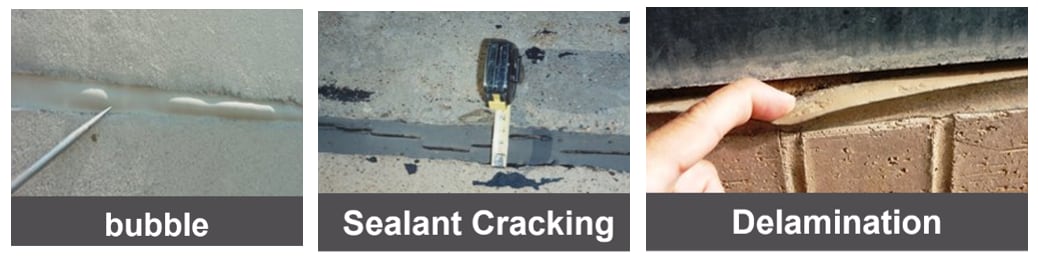
Examples of quality issues than can occur with poor sealant installation.
Sustainability
Polyurethane is known for its movement capacity, but it emits toxic volatile organic compounds (VOC) during curing. The CFS-TTS is a fully cured polyurethane which allow maximum benefits of the material while removing the potential health hazard.
Inspection
From a designing and inspection point of view, the Hilti CFS-TTS offers reliable long-term performance with two times more movement capabilities than the caulks and PU based sealants, even when installed in uneven concrete surfaces, a common job site scenario. It’s also easier to inspect as there’s no need to check if recommended thickness was applied. What is installed easily reflects what is specified.
Fully tested product
The CFS-TTS is tested and approved according to AS 1530.4:2014 and AS 4072.1:2005 in varieties of plasterboard wall configurations to allow its use in common install configurations. It also undergone the state-of-the-art local full scale acoustic test, complying with the NCC requirements for partition wall sound reduction.
Hilti is aware of customer needs in interior finishing firestop applications and offers you the technical know-how to help get it right, as well as the ability to advise you and offer engineered solutions and support during all phases of specification work.
Contact a firestop expert through our Technical Advice Services page.
