
Designing for compliance
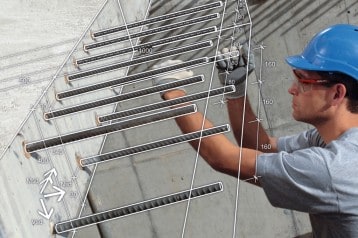
Post-installed rebar is shorthand for reinforcement bars that are installed after concrete has been poured and cured. Typically, a hole is drilled into existing concrete, and is then filled with an adhesive mortar before a length of rebar is inserted. From there, new concrete will be poured over the exposed rebar so that once it's cured, it emulates the performance of cast-in reinforcement.
The most common application for post-installed rebar is extending pre-existing reinforced concrete in structural applications - slab, wall and column extensions as well as concrete to concrete connections in staircases, beams and shear dowels.
Tensile strength can be maximised through taking the right design approach. There are several considerations to make, and a couple of different models through which you can approach design. This article will look at how to determine the best methodology for meeting compliance in your application, and how to streamline the process by making use of trusted Hilti methods.
Approvals and compliance
Before we look at design methodology it's important to understand the compliance requirements for post-installed rebar.
Currently all design provisions for post-installed anchors (rods and rebar) and cast-in channels in concrete are provided by AS 5216. The newly published standard AS 5216 has addressed this shortfall, supplying provisions for post-installed rebar applications in compliance with AS 3600 by adding the following note;
“For design provisions for stress development refer to AS 3600. For post installed rebar connections, qualifications to be done to TR 023, refer to AEFAC technical note”.
The technical note is based on codes developed by the European Organisation for Technical Assessments; EAD 330232-00-0601, ETAG 001, EOTA TR 023 and AS 3600. However, the provisions of AS 3600 are used to establish development length and tensile capacity of cast-in rebar, and don't necessary cover the behaviour of post-installed rebar.
AEFAC's technical note concludes that if a post-installed rebar system is prequalified, and installed according to the instructions outlined by TR 023, then the provisions outlined in AS 3600 can be applied to your design.
Design methodology
As previously stated, according to the application, the engineer has to choose one from the two models, the anchor model, wherein you design your rebar as an anchor following the provisions of SA TS 101/AS 5216, or the rebar model by which your rebar is designed according to the provisions of AS 3600. The key to which model you should use lies in understanding the modes of failure.
Failure modes of rebar installed with chemical anchors typically come in four types:
- Steel failure - wherein the rod or rebar breaks.
- Pullout, where rebar or rod comes right out of the hole.
- Concrete breakout, where the rebar stays connected to the concrete, but the concrete itself breaks leading to a concrete cone failure.
- Concrete splitting, where the stresses induced causes the concrete to crack around the hole.
Typically, concrete cone breakage will only happen in the anchor model, and thus, if this is a failure mode you're required to check then your designs should follow the anchor model based on the provisions of AS 5216. If the concrete cone breakage is prevented, then you can design using the rebar model based on AS 3600 with products pre-qualified or approved by EOTA TR 023.
The Hilti HIT Method for rebar design
The Hilti HIT Method has been developed to fit the rebar model mentioned above. Traditionally, the bond strength of post-installed rebar is considered to be limited, even when connecting to a surface with sufficient depth. In some cases this limited strength was offset with hooks or transverse reinforcement. Extensive research has confirmed that the bond strength of bars anchored with Hilti's mortars is greater than that of traditionally cast-in rebar. The HIT Method takes advantage of this, offering the following benefits:
- Rebar designs are no longer limited to cast in bond.
- A reduction of required embedment depth (up to 70 per cent).
- It requires less drilling.
- It requires less chemical mortar.
- It requires less labour.
- It's less expensive.
How Hilti's PROFIS software can streamline the entire process
If you're designing according the anchor model or the rebar model, you can ensure you meet all the compliance requirements by utilising Hilti's PROFIS Engineering software.