
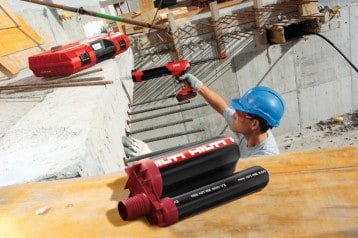
What exactly are the differences between the two chemical systems RE 500 and HY 200-R, and why would you choose one over the other?
***With updates to our products, we have published a new article covering this topic, please click HERE
If you are familiar with anchors, you will undoubtedly have heard two products being thrown around a lot: The Hilti RE 500 and HY 200-R.
Both the Hilti RE 500 and the HY 200-R are part of the Hilti Injection Technology (HIT) anchor portfolio. They’re also two of the highest-performing chemical anchor products on the market. But what exactly are the differences between the two, and why would you choose one over the other?
RE 500 versus HY 200-R
First things first, some history. Many anchor professionals will be familiar with the RE 500 and RE 500 SD. These two products were separated for different applications, however, the RE 500-V3 has combined the benefits of both, resulting in a single go-to product that can be used to cover a wide range of applications. Others may be able to recall the HY150MAX, which has since been superseded by the HY 200-R.
The easiest way to compare the RE 500-V3 and HY 200-R is by looking at each product’s respective European Technical Assessment (ETA) documents. Before we look at the key characteristics of each, however, it’s worth mentioning that both products are approved for use in post-installed rebar connections. Accordingly, a distinction should be made when referring to either product’s ETA, in order to ensure you are referencing the correct documentation for either post-installed anchor or rebar usage.
The key characteristics of the RE 500-V3 and HY 200-R that are worth comparing include:
RE 500-V3
● Slow-curing chemical anchor with 30 minutes working time and seven hours curing time at standard temperatures (20 to 24 degrees Celsius). For variable temperatures, refer to ETA documentation.
● Manual cleaning by blowing twice with compressed air, before brushing twice and blowing twice again (unless using a Hilti hollow drill bit).
● Can be installed in diamond-cored holes.
● Can be installed in diamond-cored holes where the holes are roughened using the Hilti roughening tool. This system achieves similar loading to a hammer-drilled hole.
● Can be installed in both wet and dry concrete.
● Can be used in a flooded hole if hammer-drilled and in non-cracked concrete.
● Service temperature ranges from -40 to 70 degrees Celsius.
● ETA available for 100 years service life
HY 200-R
● Fast-curing chemical anchor with nine minutes working time and one hour curing time at standard temperatures (20 to 24 degrees Celsius). For variable temperatures, refer to ETA documentation.
● Can be cleaned with a manual hand pump by blowing four times, brushing four times and blowing four times again (within limits of do up to 20 and ho up to 10 x d. Otherwise, compressed air cleaning or the Hilti hollow drill bit will need to be used).
● Can be used to install the Hilti HIT-Z rod, which requires no hole cleaning.
● Can be used to install the Hilti HIT-Z rod in a diamond cored hole.
● Can be used in diamond cored holes provided roughening tool is used. Will achieve similar bond resistance as a hammer drilled hole
● Can be installed in both wet and dry concrete.
● Service temperature ranges from -40 to 120 degrees Celsius.
For further information on each of these products, please refer to the ETAs, or feel free to ask the community here on the Hilti forum.
