
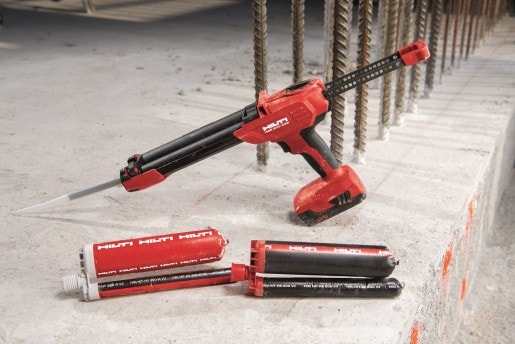
Have you ever wondered which is better? Introducing and comparing the latest versions of the RE 500 & HY 200
Some of the most frequently asked questions to Hilti engineers: What is the difference between the RE 500 and the HY 200? Which one is better? The RE 500 is better right? - is has the larger number! Which is the more expensive option?
With the latest update to our portfolio of Hilti Injection Technology (HIT) chemical anchor products, we wanted to take the opportunity to address questions like the above and provide a comprehensive comparison between the two ultimate performance products.
Before we get into the detailed characteristics and comparisons of the products, lets highlight some of the key differentiations of the products and their predecessors.
The HY 200-R was superseded by the HY 200 V3 with the key differentiator being the addition of 100 years design
The RE 500 V3 was superseded by the RE 500 V4 to achieve increased performance with additional sizes being covered for stringent requirements like seismic and 100 years design
Unfortunately comparing post-installed anchor products and determining the best or optimal solution for a connection is not as easy as going with the product that has the highest numbers. There are additional factors to consider according to requirements like environmental conditions, load types, constructability etc.
The best method of comparing chemical anchor products is to open up the European Technical Assessment (ETA approvals) for each product and comparing side by side. Otherwise a specific design comparison is recommended to be carried out using software to check failure mode calculations. For those who are not familiar with Hilti's anchor design software, please see HERE
While we are not going over an extensive ETA comparison here, we will highlight the key characteristics or features of the RE 500 V4 and the HY 200 V3 that will help decide which option to use depending on what the application requires.
RE 500 V4
- Slow-curing chemical anchor with 30 minutes working time and seven hours curing time at standard temperatures (20 to 24 degrees Celsius). For variable temperatures, refer to ETA documentation
- Optimal working and curing time for deeper embedment depths and larger sizes e.g. post-installed rebar connections
- Manual cleaning by blowing twice with compressed air, before brushing twice and blowing twice again (unless using a Hilti hollow drill bit)
- Can be installed in smooth diamond-cored holes (performance varies to standard hammer drilled holes, to be checked in design)
- Can be installed in diamond-cored holes where the holes are roughened using the Hilti roughening tool to achieve equal performance as hammer drilled hole
- Can be installed in both wet and dry concrete
- When used in wet base material, curing time should be doubled
- Can be used in a flooded hole (if hammer-drilled and in non-cracked concrete condition)
- Service temperature ranges from -40 to 75 degrees Celsius
- ETA Seismic C1 values for threaded rods M8 to M30
- ETA Seismic C2 values for threaded rods M12 to M30
- ETA covers working life of 50 years and 100 years
HY 200 V3
- Fast-curing chemical anchor with 9 minutes working time and 1 hour curing time at standard temperatures (20 to 30 degrees Celsius). For variable temperatures, refer to ETA documentation
- Optimal working and curing time suited for embedment depths up to 250mm
- Can be cleaned with a manual hand pump by blowing four times, brushing four times and blowing four times again (in uncracked concrete conditions, within limits of do up to 20 and ho up to 10 x d. Otherwise, compressed air cleaning or the Hilti hollow drill bit will need to be used)
- Can be used to install the Hilti HIT-Z rod, which requires no hole cleaning
- Can be used to install the Hilti HIT-Z rod in a diamond cored hole
- Can be used in diamond cored holes with standard HAS-U threaded rods provided roughening tool is used
- Can be installed in both wet and dry concrete
- Installation in wet concrete does not double curing time
- Service temperature ranges from -40 to 120 degrees Celsius
- ETA Seismic C1 values for threaded rods M10 to M30
- ETA Seismic C2 values for threaded rods M16 to M24
- ETA covers working life of 50 years and 100 years
For any additional information or queries on any of the above, please post on the Ask Hilti Forum, or reach out to Hilti engineers directly through our Anchor Design Services
